Review the scenario below, then answer the questions which follow, using the UML diagram below.
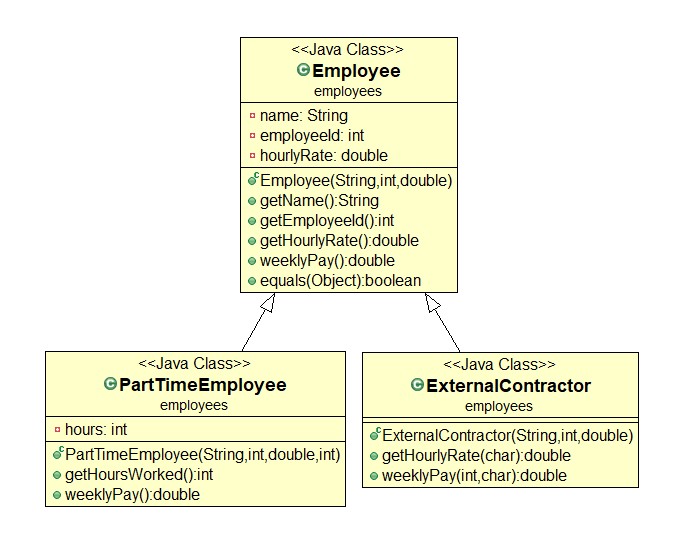
This UML may represent the partial design for an
Employee Management System (sometimes referred to as an
Employee Information System or Human Resources Information System)
for a business or organization.
Such systems are often used to support tracking and managing of
employee information and related process.
This may including recruitment and applicant tracking, payroll
administration, vacation and benefits administration, time and
attendance management, training, and performance management.
An Employee Management System would need the ability to track
and manage many different instances of the Employee objects
(as well as many instances of Employee subclasses, such as
ExternalContractor, PartTimeEmployee).
To accommodate this requirement the design should be amended to include:
- Nothing else is needed, the design is perfect as is!
There are no hints for this question